Safe by Design
Aged Care Environments
 Working Prototype
by Opposite
Working Prototype
by Opposite
Working Prototype
by Opposite
Working Prototype
by Opposite
An interactive planning tool that turns manual handling and occupational violence standards into live, visual design decisions, so safer environments are built in rather than retrofitted.
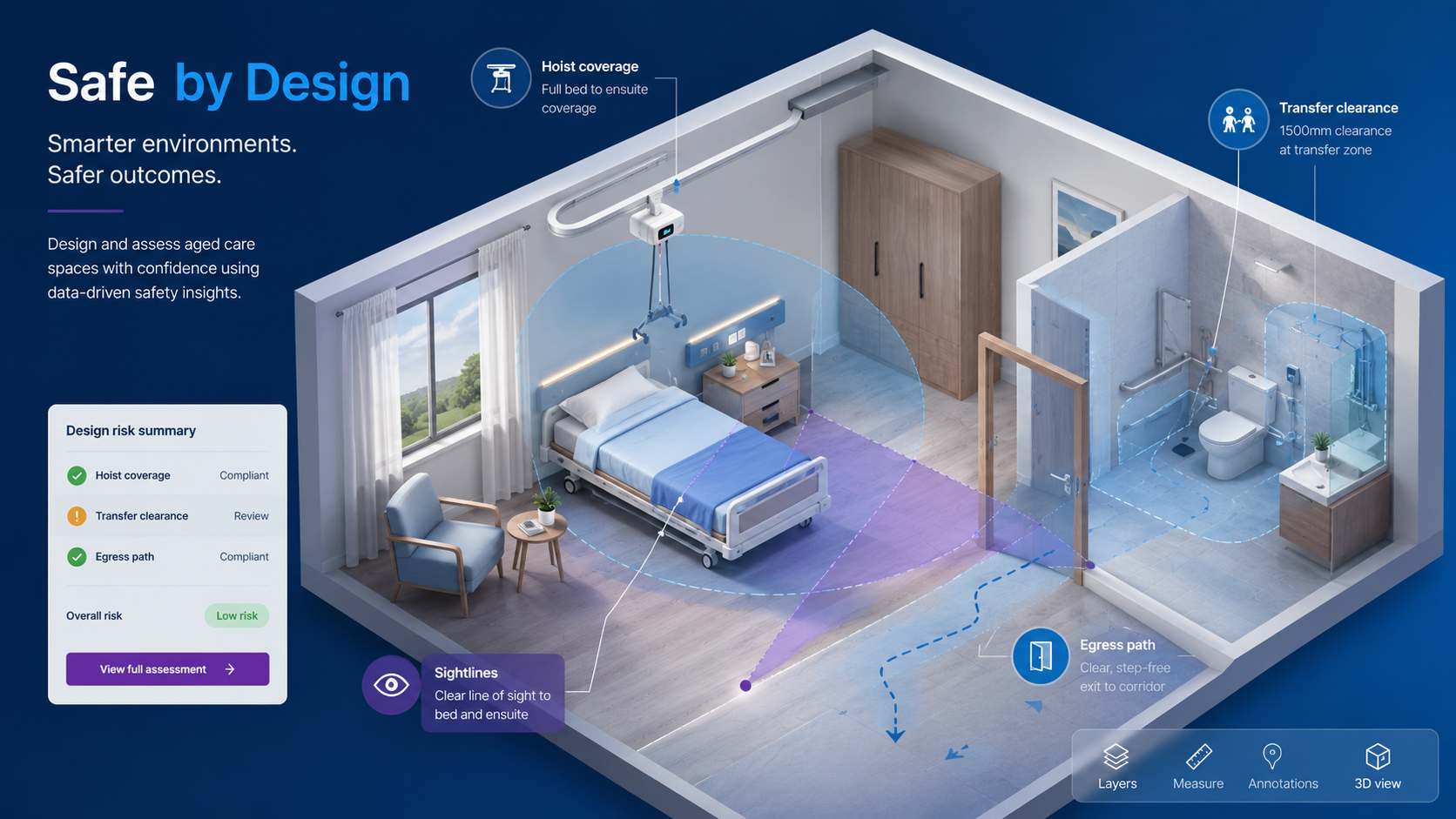
The room is the unit of assessment. Set the project context, arrange fixtures and equipment on a live plan, and watch the design risk respond in real time, each flag linked back to the standard that explains why.
Capture project type, room purpose and resident profile, a dementia bedroom carries different design rules to a bariatric ensuite, and the platform tailors guidance accordingly.
Drag ceiling hoist coverage, beds, doors and sightlines onto the room. Reach zones, transfer clearances and blind spots update instantly as you move things.
A plain-language risk picture, the equipment the design assumes, and the outstanding actions, ready for design reviews, governance and the safety-in-design file.
Administrative controls, training, procedures, safe-work method statements, do the least and fail the most. This platform pushes every recommendation toward elimination and engineering, because the cheapest place to remove a risk is the drawing board.
Designing workplaces for safer handling of people; transferring people safely; prevention of violence and aggression in health services.
University of Wollongong dementia design research, reducing agitation and OVA triggers through the built environment.
Room sizing, circulation and clearance benchmarks adapted for the aged care context.
Benchmarked against award-winning services and public health psychogeriatric settings.
The demo loads a real dementia bedroom and ensuite, pre-flagged against Fleming's principles and safe manual handling standards. Move things around and watch the risk respond.
Context tailors every recommendation, so you see the rules that apply, not a generic checklist.
Determines whether we optimise for a clean-sheet design or work within existing constraints.
Each standard is a visual card: the principle, what good looks like, the common mistakes, and the equipment it assumes, with the source reference and a technical illustration for each.